The inception of anti-retroviral therapies (ART) as treatment options for HIV/AIDS sufferers has been pivotal in increasing health outcomes for patients. Not only does ART save lives on an individual level, it also decreases HIV transmission rates by up to 96%1, providing benefits on a larger scale. However, there are still significant disparities in access to these medications around the world – particularly in Africa.
The Good
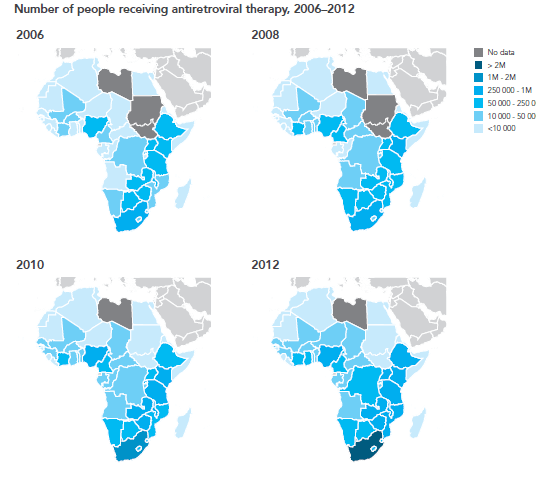
Africa leads the world in terms of expansion of access to ART, with 7.6 million people across the continent of Africa receiving ART in 2012 (most recent data). With access to ART steadily increasing associated morbidity and mortality is currently declining. However, most of this movement is occuring in the more developed regions in Africa. Consequently, there are still gaps that persist in the realm of HIV/AIDS treatment and care.
Source: http://goo.gl/mbWQb2
The Bad
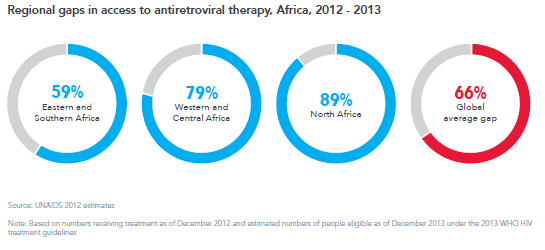
As is shown in figure 2 below, access to ART is relatively high in South and East Africa. However, access in West, Central and North Africa is extremely limited with figures for gaps in access as high as 89%. As a result, it is estimated that around three quarters of HIV-infected sub-Saharan Africans have not achieved viral supression2. Furthermore, the decrease in AIDS related mortality is not uniform amongst all groups. Tragically, adolescents (aged 10-19 years) are over-represented in terms of AIDS related deaths – the only age group where deaths have increased from 2001-20122. Adolescents are also have the largest ART gap of any age group, with an estimated 72% of eligible African adolescents not receiving treatment and a staggering 94% of North Africans.
Source: http://goo.gl/mbWQb2
Why?
The reasons for gaps in treatment are numerous. Access to ART is complex and encompasses a spectrum of societal, cultural, financial and legal factors. Our upcoming articles will hone in on some specific examples of barriers to access, as well as suggestions for improving access where it is needed and for whom it is needed.
References
1. Cohen MS, Chen YQ, McCauley M, Gamble T, Hosseinipour MC, Kumarasamy N, et al. Prevention of HIV-1 infection with early antiretroviral therapy. New England journal of medicine. 2011;365(6):493-505.
2. HIV/AIDS JUNPo. Global report: UNAIDS report on the global AIDS epidemic: 2012. UNAIDS; 2012.
 Bringing aid to the unaided
ART seems like an incredibly crucial in slowing the progression of HIV infection. Does ART remains effective for individuals diagnosed with late stage HIV infection or for those who have already progressed to AIDS?
LikeLike
Hey Will! ART is still first-line therapy for AIDS patients, however the treatment is much more effective when given early. For a bit more info on ARV therapy, watch this neat Khan Academy video on the topic!
LikeLike
This is a really interesting article, great job! I recently read about Truvada, a pre-exposure prophylactic anti-retroviral drug to prevent contracting HIV. Is this drug available in Africa?
LikeLike
Thanks for your comment Marissa! You probably only recently read about Truvada because it’s such a recent drug – in fact, it was only approved for use in preventing HIV transmission in 2012! As such, many of the TRIPS-agreement patents still stand, and the company that produces Truvada can essentially charge whatever it likes for it. A years dose of Truvada cost between 8,000 and 14,000 US dollars in 2015 – much too expensive for many Africans to afford! Although Truvada would be an ideal preventative measure against HIV transmission in Africa, it is unfortunately unrealistically expensive at this current stage.
LikeLike